

Showing posts with label number sense. Show all posts
Showing posts with label number sense. Show all posts
"What 2 Numbers?" Multiplication Facts Practice for Middle and High School Students

What the heck are fraction exponents?

Print and Digital Number Puzzles

My daughter and I recently worked on a 550-piece puzzle, which took us just under a week to complete. We worked on it on the floor a bit each day after school, hiding it from the cats each night. It had been over 20 years since I had worked on a puzzle that was more than 30 pieces (kid puzzles), so it surprised me how much we both enjoyed it. Figuring out where the pieces went was relaxing and enjoyable, and I could feel it exercising my brain in ways that it doesn't usually exercise.
Working on that puzzle with my daughter got me thinking about making puzzles, so this past week I started making some math puzzle sets that cover various curriculum topics. Students can work on these math puzzles as classwork, in centers, with a partner or as a review activity. In this post, I want to show you a few of these new math puzzles.

Simplifying fractions using visual models and primes video

My favorite way to simplify fractions is by working through a list or prime numbers, checking if both numerator and denominator divide by each larger prime. I like this method because it makes simplifying fractions super concrete for students who need it. It also helps eliminate errors that can occur when a factor is missed. Students who aren't as confident with their division facts can even use a calculator (or divisibility rules) to check each prime.
Estimating square roots using visual models video

A teacher messaged asking if I had a video showing how to estimate square roots using manipulatives. I didn't, but it sounded like a lot of fun to make a video on this topic.
Hands-on Even & Odd Number Investigation!

Like people all over the world, I have been grappling with my newfound kindergarten homeschooling position after telling myself for many years that I could never teach another human being how to read. But here we are, reading, writing, learning sight words and doing lots of math. School has been great about sending activities and ideas and I've filled in with things found online and resources I make based on questions that arise.
I let my daughter take the lead by asking what she'd like to learn (often I get an "I don't know" but sometimes she'll give me something) and build on places where she's had questions. This has been one great benefit of this time in quarantine. Especially as an only child, she is especially missing her peers but this time together as her teacher has allowed us to sort of bond over math.
In this post I want to share a hands-on investigation into even and odd numbers that we worked on together.
Dividing Fractions by Fractions using Visual Models - 3 examples

Explaining how to divide fractions conceptually is one of those topics I find myself needing a refresher on every so often. For me, showing how to divide fractions using visual models is definitely one of those "don't use, lose" situations. So this post came from me recently refreshing my memory of fraction division. But why now? This post:

After sharing Howie Hua's post in our Visual Math Facebook group, it got me reminiscing on fraction division. And full disclosure, I had never considered dividing across as a thing to do. I'm 42 with a Masters in Math for Teaching and this never crossed my mind. I'm not usually too worried about how I come across, but I did appreciate other teachers in the group admitting they never thought of this, either. It allowed us all to learn something new together, and I love when this happens.
In one graduate class we had to write papers on the various algorithms taught in math and why they work. Fraction division was one of those algorithms, and after more than a few "redo"s written at the top of my paper, I finally handed in a paper that could actually be graded. Needless to say that was a taxing class.
Keep, change, flip. Why? I hope to answer that with the 3 examples in this post.
Example 1: (2/3)÷(1/2)

Division asks, "How many of these fit into that?" For 10 divided by 2, for example, we're asking, "How many 2's fit into 10?" We ask the same question when we divide fractions, it's just a little harder to see.
In our first example (2/3)÷(1/2), we're asking, "How many 1/2s fit into 2/3?" It would be easier to answer this question if our fractions were broken into the same number of parts. By creating a common denominator, it will be easier to see how many will fit.
By creating the common denominator 6, we can then see that all 3 of our green bars will fit into the space taken up by our blue bars. There is even room for one more! So all of the green bars (1 whole) can fit into the blue space and 1 more bar out of the 3 (1/3). So (2/3)÷(1/2) = 1 and 1/3.
Here is a video explaining:
The connection to Keep Change Flip:
When I posted this video on my Instagram feed, one teacher pressed me for the connection to the keep change flip (aka: multiplying by the reciprocal) standard algorithm. Like anything in math, there is more than one good way to make a connection. I personally like bringing it back to whole numbers when explaining why keep change flip works:

Example 2: (1/2)÷(2/3)
This example is just like example 1, we just switched the fractions' placements, which is fun because it reinforces that division is not commutative.

In our second example (1/2)÷(2/3), we're asking, "How many 2/3s fit into 1/2?" By creating a common denominator, we can easily see that 3 of the 4 blue bars will fit into the space occupied by the green bars. So (1/2)÷(2/3)=(3/4).

Here is a video:
Example 3: (4/5)÷(2/3)
Sometimes creating a common denominator with just columns would get too messy to be helpful, so we can create a grid to show it instead. We can always do this, I just prefer columns when there is a chance to use them because I feel they are easier to see.

With (4/5)÷(2/3), our common denominator is 15, so we can create a grid of 15 spaces. 4/5 takes up 12 of these spaces and 2/3 takes up 10 of these spaces. So all of our 2/3 can fit into 4/5, plus an additional 2. We can then see that (4/5)÷(2/3) = 1 and 2/10.
Here is a video explaining this example:
Summary:
All three fraction by fraction division examples from this post are in this video:
In one graduate class we had to write papers on the various algorithms taught in math and why they work. Fraction division was one of those algorithms, and after more than a few "redo"s written at the top of my paper, I finally handed in a paper that could actually be graded. Needless to say that was a taxing class.
Keep, change, flip. Why? I hope to answer that with the 3 examples in this post.
Example 1: (2/3)÷(1/2)

Division asks, "How many of these fit into that?" For 10 divided by 2, for example, we're asking, "How many 2's fit into 10?" We ask the same question when we divide fractions, it's just a little harder to see.
In our first example (2/3)÷(1/2), we're asking, "How many 1/2s fit into 2/3?" It would be easier to answer this question if our fractions were broken into the same number of parts. By creating a common denominator, it will be easier to see how many will fit.
By creating the common denominator 6, we can then see that all 3 of our green bars will fit into the space taken up by our blue bars. There is even room for one more! So all of the green bars (1 whole) can fit into the blue space and 1 more bar out of the 3 (1/3). So (2/3)÷(1/2) = 1 and 1/3.
Here is a video explaining:
The connection to Keep Change Flip:
When I posted this video on my Instagram feed, one teacher pressed me for the connection to the keep change flip (aka: multiplying by the reciprocal) standard algorithm. Like anything in math, there is more than one good way to make a connection. I personally like bringing it back to whole numbers when explaining why keep change flip works:
If 10 divided by 2 is 5,
Then half of 10 is 5.
So 10 divided by 2 is 1/2 of 10.
We can multiply by a reciprocal for division.
If you'd like to link the keep change flip algorithm straight to this fraction example, here is how that can be done:
We can see that the numerator of the second fraction becomes the denominator of our answer. This is because we are asking, "How many of the second fraction's numerator (bars) can we fit into the first fraction's numerator [after we create a common denominator]?"
We can see that the numerator of the second fraction becomes the denominator of our answer. This is because we are asking, "How many of the second fraction's numerator (bars) can we fit into the first fraction's numerator [after we create a common denominator]?"

Example 2: (1/2)÷(2/3)
This example is just like example 1, we just switched the fractions' placements, which is fun because it reinforces that division is not commutative.

In our second example (1/2)÷(2/3), we're asking, "How many 2/3s fit into 1/2?" By creating a common denominator, we can easily see that 3 of the 4 blue bars will fit into the space occupied by the green bars. So (1/2)÷(2/3)=(3/4).

Here is a video:
Example 3: (4/5)÷(2/3)
Sometimes creating a common denominator with just columns would get too messy to be helpful, so we can create a grid to show it instead. We can always do this, I just prefer columns when there is a chance to use them because I feel they are easier to see.

With (4/5)÷(2/3), our common denominator is 15, so we can create a grid of 15 spaces. 4/5 takes up 12 of these spaces and 2/3 takes up 10 of these spaces. So all of our 2/3 can fit into 4/5, plus an additional 2. We can then see that (4/5)÷(2/3) = 1 and 2/10.
Here is a video explaining this example:
Summary:
All three fraction by fraction division examples from this post are in this video:

I also just created this set of fraction division task cards to go along with this post. The cards can be laminated and used with a dry erase marker so that they can be reused.

And for a fun review, this fraction review digital math escape room. In puzzle #5, students are asked to multiply and divide fractions. Students figure out the 4 answers then type their 4-letter code into the answer-validated Google Form to unlock the puzzle.
I hope this post has been helpful!
-Shana McKay, Scaffolded Math and Science
 |
| Fraction review digital math escape room |
-Shana McKay, Scaffolded Math and Science

A hands-on prime vs. composite numbers investigation

If your students struggle with the idea of prime vs. composite numbers, this hands-on investigation activity into prime numbers may be helpful, especially to the kinesthetic learners in your classroom.
Ideas for Teaching Number Sense

In 2013, NPR published "Scientists Put a 'Sixth Sense' For Numbers on Brain Map". The article summarized scientists' findings on a region of the brain responsible for our ability to estimate quantities.

Quantities of pencils on the floor, quantities of tiles on the ceiling, quantities of flowers in a vase. Without counting, how close can you get to estimating the correct number of objects you see?
Number Talks in High School Math


As a teacher, there can be long stretches of time when I don't at all feel successful. My kids aren't getting it, they're not engaged, they aren't submitting work. Number Talks fix all of this. They are super low-prep with super high pay off.
When I use Number Talks in my classroom, engagement goes way up as well as student feelings of success. Students I think would rather be somewhere else - anywhere else - are able to explain their thinking to the class.
I need to thank Jennifer from Smith Curriculum and Consulting for the push I needed to bring Number Talks into my classroom. You can read more about her experience with Number Talks in her post Analyzing Relationships in Math.
As simple as Number Talks turned out to be, they were super intimidating at first.
I watched a few videos on YouTube to see them in action to get an idea of what types of problems are asked, what kids do and what teachers do. What I found was that the most successful Number Talks seemed to be the ones where the teacher didn't say much. I modeled my own behavior after the teacher in this number talks video who kept her words to the bare minimum and whose students seemed super engaged.
UPDATE: Teacher Ms. Streich sent another number talks video to watch.

Hand signals are a part of Number Talks and there are different signals for thinking, having an answer, having more than one strategy and agreeing with what is said.
Because I worry that my high schoolers will think hand signals are corny, I give each student an index card with a check mark on one side. When I hand out the cards, the check mark is facing down. When students are done thinking and have an answer, the direction is to flip over their card to show the check mark. This way the room stays calm and I can still tell who is ready.

Next comes the uncomfortable part - no calculators, pencils or paper. My students are so used to using calculators that this part was tough for them. Then when I say no paper or pencils either.... this part takes the most adjusting to. But in the end, it's all worth it. Number Talks are awesome.

And finally the numbers come in. Because I want my students to be able to calculate tips and discounts without needing to bust out a calculator, it made sense for us to do Number Talks with percents.
We started really simply with 10% of 50. Going into this, I figured every kid would just say they moved the decimal one spot to get 5. Of my students who chose to explain their thinking to our class, one moved the decimal, one multiplied 0.10 by 50 and one multiplied 10/100 by 50.
It was then that I realized how powerful Number Talks are. They got my students engaged, thinking and even explaining their work. Over the course of 5 or so Number Talks, I saw students who thought they'd never be able to calculate percents in their heads gain confidence in not needing a calculator.
It was then that I realized how powerful Number Talks are. They got my students engaged, thinking and even explaining their work. Over the course of 5 or so Number Talks, I saw students who thought they'd never be able to calculate percents in their heads gain confidence in not needing a calculator.
If you're like me and have been wanting to give Number Talks a try but feel a little intimidated by starting, you can download these Number Talks slides for free from my Google Drive.

A manipulative for integer operations - negative number adding tool
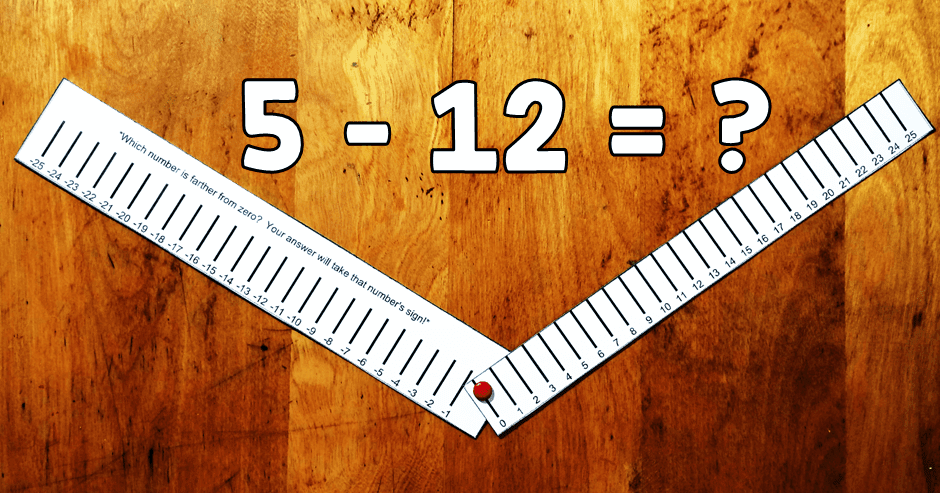
Integer Operations Manipulative
Working with negative numbers has always been a sticking point for my students, whether they are just learning about integers or they are solving equations or factoring quadratics. Why?